California's Plug-and-Play Solar Law: What It Means for San Diego and La Mesa
The Short Version
On September 30, 2026, Gov. Newsom signed SB 868, the Plug and Play Solar Act. Starting January 1, 2027, Californians can plug small solar setups (up to 1,200 watts) straight into a regular wall outlet. No utility permission. No interconnection paperwork. No fees from SDG&E.
That's big news for renters, condo owners, and anyone whose roof just isn't solar friendly. In La Mesa, more than half of homes are rented, so this one hits close to home.
But here's the part that tripped me up. I had to look it up myself, so you don't have to. These panels don't let you go off the grid. They won't keep your lights on in a power outage. And no, you can't just plug them into your Tesla Powerwall. I'll explain why below...
Quick Answers
What is the Plug and Play Solar Act? It's California Senate Bill 868, authored by Sen. Scott Wiener and signed September 30, 2026. It lets residents use certified plug in solar systems up to 1,200 watts without a utility interconnection agreement or fees.
When can I use plug-in solar in San Diego? The law takes effect January 1, 2027. Compliant products aren't on shelves yet. Sen. Wiener's office expects them around spring 2027.
Does plug-in solar work during a power outage? No. The law requires anti-islanding protection, so the system shuts off within seconds when the grid goes down. That protects utility crews working on the lines.
Can renters use plug-in solar? The law removes the utility roadblocks for renters. It doesn't override your lease, so you still need your landlord's okay.
Can plug-in solar charge my Tesla Powerwall? Not directly. It plugs into a wall outlet, not your battery. It lowers your home's power draw, which can indirectly leave more rooftop solar for your battery, but that's about it.
What the Law Actually Does
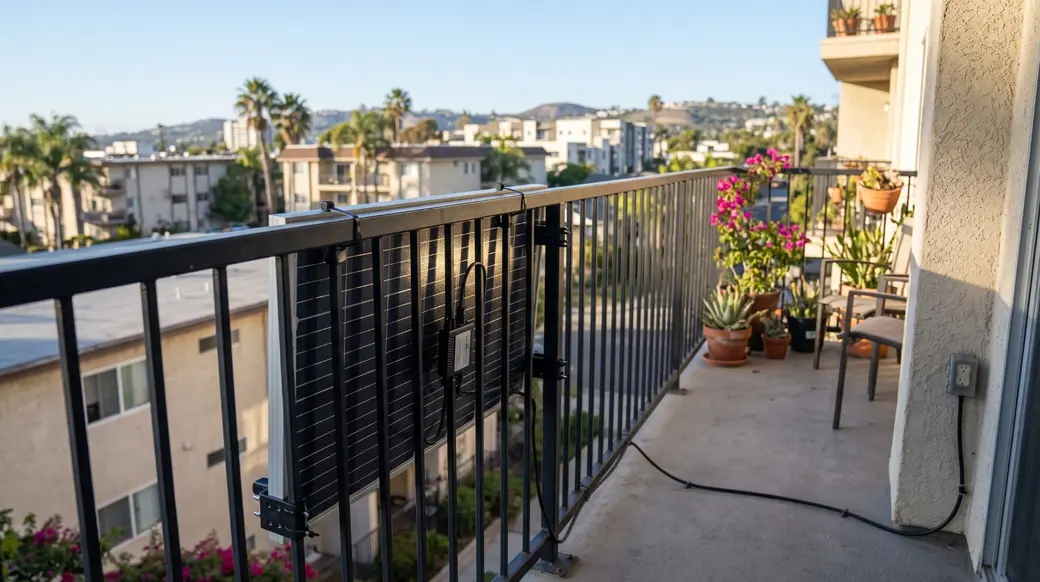
Plug in solar (you'll also hear "balcony solar") is a small kit. A panel or two, a little inverter, and a cord that plugs into a standard 120-volt outlet. The power it makes flows into your home's wiring and gets used first by whatever's running. Fridge, laptop, the window AC you swore you'd replace three summers ago.
These kits have been huge in Germany for years. Until now, California made them a pain. You needed the same utility sign off as a full rooftop system, and that paperwork often cost more than the kit.
Here's what SB 868 changes:
|
Rule |
What it means for you |
|---|---|
|
1,200-watt cap per home |
Enough to run something like a window AC unit. Not your whole house. |
|
UL (or equal) certification required |
Only tested, approved kits qualify. Cheap knockoffs don't. |
|
Must meet electrical codes |
Has to follow national and California electrical code. |
|
No interconnection agreement |
You don't need SDG&E's permission to plug in. |
|
No utility fees |
Utilities can't charge you for using one. |
|
Optional free registration |
Utilities can ask for a quick online form with your address, make, model and size. |
|
Anti-islanding required |
It shuts off automatically when the grid goes down. |
|
Exemption sunsets Jan. 1, 2030 |
Lawmakers have to extend it, or the old rules may come back. |
A few other things worth knowing. Kits currently run about $300 to $2,200 depending on size, according to KQED. Utilities can't demand fees or advance approval, per Electrek. And there's no credit for extra power you send back to the grid. If you don't use it, you lose it.
The Fine Print I Had to Look Up
If you heard "plug in solar" and pictured breaking up with SDG&E forever, I get it. Nope. Here's what these systems can't do.
It won't take you off the grid
Plug in solar is grid-tied. It needs live utility power coming into your home to work at all. It's a helper, not a replacement. On a sunny afternoon it trims what you pull from SDG&E. At night, you're right back on the grid like everyone else.
It won't run during a power outage
This surprised a lot of people. The law requires an anti-islanding feature. When the grid goes down, the system shuts off within seconds.
Why? Because a lineworker fixing a downed line expects that line to be dead. If your panels kept pushing power out through your outlet, that wire could be live. So during a Red Flag shutoff or a summer heat wave outage, your plug-in panels sit there doing nothing. Sun's shining. Lights are off. Feels a little rude...
One exception: some kits come with their own small built-in battery and backup outlets. Those outlets can run a phone charger or a lamp during an outage. But only things plugged directly into the kit. Not your home's wall outlets.
Can it charge a Tesla Powerwall I already have?
Short answer: not directly. Your Powerwall is wired into your electrical panel by an installer. Your plug in kit goes into a regular wall outlet. The two don't talk to each other.
Here's what actually happens when the grid is up:
- The kit lowers your home's power use. Your house just looks like it's using less electricity.
- If you have rooftop solar too, that lower use can leave a little more rooftop power for the Powerwall to soak up. That's an indirect bump, not real charging.
- If your Powerwall has no rooftop solar, you're just saving a bit on daytime power. The battery doesn't see it.
- If your home uses less than the kit makes, the extra goes back to the grid. Free. No credit.
What about during an outage? This is where it gets murky. In a home with a Powerwall, backed up outlets stay powered when the grid drops. A plug-in kit on one of those outlets might think the grid's still there and start producing. Tesla uses its own system to manage solar it knows about. It doesn't know about your plug-in kit. Tesla's own support page says Powerwall isn't designed to work with other energy sources beyond compatible solar inverters.
My advice? Don't experiment with this. If you have a Powerwall or any home battery, call your solar installer before plugging anything in. Ask about warranty and safety. A $500 kit isn't worth risking a $15,000 battery system.
Who Wins and How
SDG&E's April 2026 rate notice put the average residential rate at about 46.4 cents per kWh. That's why even a small panel matters here. Sen. Wiener's office estimates plug-in systems can save a household up to $450 a year. KQED reports up to $500 a year for a small apartment, or roughly 20% of its power use. Your results depend on sun, shade, and when you actually use power.
Renters
Renters win the most. Until now, solar was basically an owner only club. You can't put panels on a roof you don't own, and you're not about to drop thousands on your landlord's house.
Now you can buy a kit, hang it on a balcony or set it in a sunny yard, and take it with you when you move. It's yours, like a couch.
The catch: SB 868 doesn't override your lease. It removes the utility hurdles, not the landlord ones. Ask in writing before you mount anything. Most leases have rules about balconies, railings and changes to the property.
SDSU and College Area Rentals Guide
Future home buyers
If you're renting now and saving to buy, this is a nice way to chip away at your power bill. At $450 a year, that's close to $40 a month you're not sending to SDG&E. Small, but it adds up toward a down payment.
When you do buy, here's the thing to know. A plug in kit is personal property. It usually leaves with the seller, like a TV or a patio set. Don't assume it comes with the house. If you want it, write it into your offer.
And for condo and townhome buyers: check the HOA rules. Some HOAs restrict what you can hang on balconies or railings especially if that balcony or railing are private property or not.
Current homeowners
If your roof faces the wrong way, has too much shade, or is due for replacement, plug in solar is a low cost way to get some solar without a big install. A kit on a sunny patio or fence line can trim your daytime bill.
If you already have rooftop solar, check with your installer and SDG&E first. Adding unapproved generation could raise questions about your existing interconnection agreement. SDG&E were against this legislation to begin with.
And if you're thinking about selling soon, don't expect a plug in kit to boost your home's value. It's portable. Buyers will see it as a nice extra at best, not a feature like owned rooftop solar.
Why This Matters in La Mesa
La Mesa is a renter heavy town. Census data for 2020 to 2024 shows only 47.7% of homes are owner-occupied. That means more than half of La Mesa households have been locked out of solar until now.
A few local things to think about:
- Apartments and condos. From the Grossmont Center area down to the SDSU and College Area rentals, there's a lot of multi-unit housing. Plenty of those units have a balcony or patio with afternoon sun. That's exactly who this law was written for.
- Older single-family homes. Many La Mesa homes have mature trees, older roofs, or odd roof angles. If a solar company told you your roof "isn't a great fit," a kit on a sunny side yard might be.
- Hot East County summers. La Mesa gets warmer than the coast. A 1,200-watt kit running a window AC on a sunny afternoon is about the best use case there is.
- Costs are real here. Median rent in La Mesa was $2,049 and the median home value was $812,000 in that same Census data. Every bit of monthly savings counts.
What Is Your La Mesa Home Worth Right Now??
One more local reality check. If you live somewhere SDG&E sometimes shuts off power on high fire risk days, plug-in solar won't help you during those shutoffs. Same rule as any outage. It turns off.
Solar panels on a home has become an attractive, if not required "feature" of a home for home buyers in and around La Mesa. Utility bills are just so high now and with the inflated cost of housing, its getting harder and harder for families to make a purchase work.
What is it Really Like To Live in La Mesa, A No Fluff Guide
Chris's Take
I like this law. Anything that gives renters a real shot at lowering their bills is a win in my book. And with SDG&E rates where they are, small savings ain't that small.
But I'd be wrong to let you think this is a backup power plan. It's not. It won't power your house in an outage, it won't take you off the grid, and it won't plug into your Powerwall. It's a bill trimmer. A good one, but that's the job.
If you want real backup power, that's a bigger conversation with a licensed solar and battery installer. And if you're buying a home and backup power matters to you, tell me early. It changes which homes we look at.
I have 21 solar panels on the roof of my own home as it covers our electricity bill through the year including charging an EV. I know many homeowners who have a few panels or have a full array that are older and produce less, so this could be a good way to supplement your energy pull from the grid and relieve some of the financial burden.
FAQ
Is plug-in solar legal in California right now? The law takes effect January 1, 2027. Until then, the old utility rules still apply.
How big can a plug-in solar system be? Up to 1,200 watts of AC output per home.
Do I have to tell SDG&E? You don't need permission. Utilities can ask you to fill out a free, simple online registration with your address and system details.
Can I buy a kit online today and use it in 2027? Be careful. Kits must be certified by UL or an equivalent lab and meet California code. Compliant products are expected around spring 2027.
Will SDG&E pay me for extra power? No. There's no credit for power your kit sends back to the grid. Use it while it's being made.
Does a plug-in solar kit come with the house when I buy? Usually not. It's portable personal property. If you want it, put it in your purchase agreement.
Is this law permanent? Not yet. The utility exemptions sunset January 1, 2030, unless lawmakers extend them.
Can I use plug-in solar if I live in a condo with an HOA? Possibly. Check your CC&Rs and talk to your HOA before mounting anything on a balcony or railing.
What to Do Next
If you're a renter, start by asking your landlord. If you're a homeowner with a battery, call your installer before you buy anything. And if you're thinking about buying or selling in La Mesa or anywhere in East County, and want to talk through what solar (or no solar) means for a home's value, I'm happy to help. No pressure. Just a conversation...
Sources
- KQED: California Officially Legalizes Balcony Solar (signing date, 1,200-watt cap, kit prices, savings)
- Solar.com: California Legalizes Plug-In Solar (Jan. 1, 2027 effective date, outage shutoff, 2030 sunset, spring 2027 products)
- Electrek: California gives the green light to balcony solar (no fees, online notification rules)
- pv magazine: Newsom signs California plug-in solar bill (utility rules, sunset)
- Sen. Scott Wiener press release (bill name, up to $450 a year savings)
- SDG&E April 2026 Electric Rate Change Alert (46.4 cents per kWh average)
- U.S. Census QuickFacts: La Mesa (47.7% owner-occupied, $2,049 median rent, $812,000 median value)
- Tesla: Combining Systems with Powerwall (compatibility limits)
- Solar Waypoint: Does Plug-In Solar Work During a Power Outage? (anti-islanding, built-in battery outlets)
 Chris Melingonis - The Realtor Dad
Chris Melingonis, also known as The Realtor Dad, is a La Mesa and San Diego real estate agent with over 20 years of experience helping buyers and sellers throughout La Mesa, San Diego, and surrounding East County communities. He has earned more than 30 five-star client reviews across Google and Zillow and writes about local real estate, neighborhoods, home values, buying, selling, and San Diego housing trends.
Recent Posts