Inheriting a Parent’s Home in San Diego: A Calm, Practical Roadmap
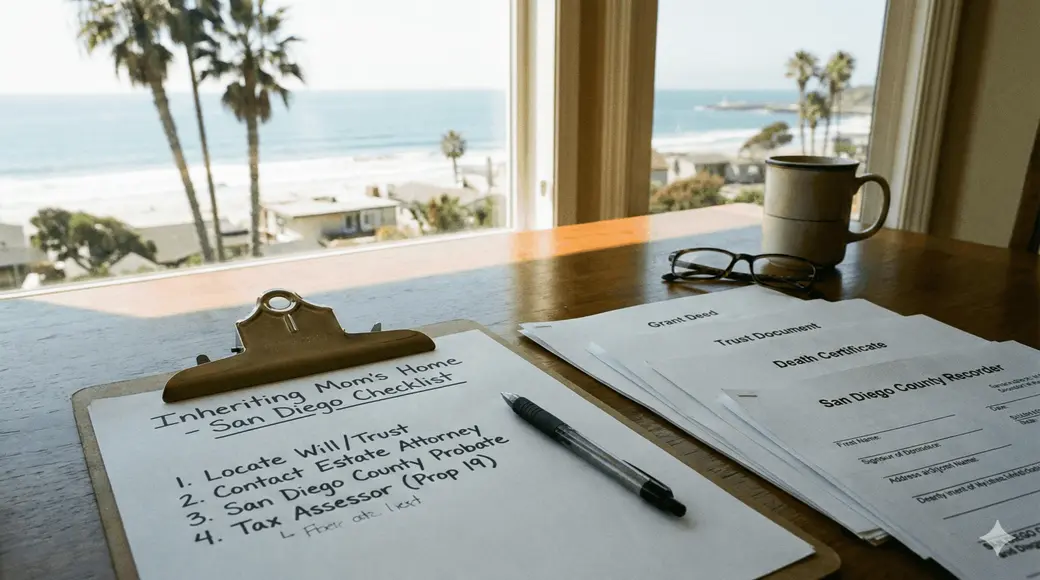
Inheriting a Parent’s Home in San Diego: A Calm, Practical Roadmap for Overwhelmed Families
Estimated reading time: 18 - 25 minutes - Last Updated 2/23/2026
Important disclaimer (read this first)
This article is general education for California (with a San Diego County lens). It is not legal, tax, or financial advice. Your situation may be different because of your family dynamics, documents, debts, or changing laws (especially tax rules). Always confirm with an experienced California estate attorney, CPA / tax pro, and other licensed professionals before making major decisions.
Laws and forms change. Always verify with current official sources like the California Courts, San Diego County Assessor / Recorder / County Clerk, and tax agencies.
Why this feels so hard (and what “inheriting the home” really means)
When a parent or elder loved one dies, you’re grieving and also suddenly responsible for a house: mortgage payments, lock and alarm codes, mail piling up, neighbors asking questions, and family opinions about “what we should do.” It’s emotional and often urgent at the same time.
“Inheriting the home” is not just one scenario. In California, the legal path depends on how the property was owned and what documents your loved one left behind:
-
A living trust (often called a revocable trust), where the trust - not the individual - is the legal owner, and a successor trustee takes over to manage and eventually transfer the home.
-
A will, which usually means a probate court process unless all assets are set up to avoid probate or qualify for simplified procedures.
-
Joint tenancy or community property with right of survivorship, where a surviving co-owner may record an affidavit and supporting documents to clear title into their name.
-
A Transfer-on-Death (TOD) deed, where a named beneficiary records documents after death to become the owner (if the deed was properly executed and not revoked). California treats this differently than a living trust or joint tenancy.
-
No trust, no will, no survivorship, no TOD deed, which often means a probate case in Superior Court before the home can be legally transferred or sold.
On top of that, San Diego County adds its own layer: Assessor and Recorder forms, change-in-ownership filings within set timelines, and potential property tax reassessment under Proposition 19.
The goal of this guide is to give you a calm, plain English roadmap from “we just lost mom” to “we’ve handled title, taxes, and the house is either sold, kept, or rent - ready.”
At-a-Glance Roadmap: From Death to Rent-Ready
Think of this as your big-picture checklist. Each step is expanded later.
-
First week: Get certified death certificates, secure the house (locks, alarms, mail, utilities, insurance), locate key documents (trust, will, deed, mortgage, tax bills, insurance).
-
Confirm the legal path: Determine how the home was owned (trust, will only, joint tenancy, community property with survivorship, TOD deed, or no plan) and whether probate or simplified procedures are required.
-
Decide if you need a lawyer: Simple, aligned heirs with clear documents may partly DIY; contested, complex, or high dollar situations usually need a probate / estate attorney.
-
Handle San Diego County paperwork: File required Assessor forms (Change in Ownership, parent - child exclusion claim if applicable), and record needed documents (Affidavit of Death, deeds) with the Recorder after getting professional guidance.
-
Address taxes and money: Understand property tax reassessment and Prop 19, step-up in basis for capital gains, estate income tax issues, and potential rental income tax if you hold and rent.
-
Coordinate if you’re out of state: Arrange keys, local help, vendors, notarization, and digital systems so you can manage the process from afar.
-
Clean out the house and handle personal property: Make family agreements, inventory sentimental and valuable items, donate / sell what makes sense, and handle sensitive documents safely.
-
Get the home minimally rent-ready: Focus on safety, habitability, detectors, basic repairs, cleaning, and compliance with California landlord rules; avoid over renovating without a clear plan.
-
Choose your endgame: Decide whether to sell, keep, rent, or buy out a co-heir; document any agreements and consider mediation if there’s disagreement.
-
Complete title transfer and reset responsibilities: Ensure the new owner(s) are on title, insurance is updated, property taxes are correctly set, and someone is clearly responsible for ongoing costs.
San Diego Home Value Estimate For Inherited Property
Step-by-Step Guide
Step 1: Immediate First-Week Actions
In the first 7 days, focus on safety, preservation, and information - not big decisions.
1) Get certified death certificates
-
Order multiple certified copies through the county where the death occurred or via the funeral home.
-
You’ll likely need them for the court, banks, insurance, and to record certain documents (like an Affidavit of Death) with the San Diego County Recorder.
2) Secure the property
-
Change or rekey exterior locks if appropriate, especially if many people had keys.
-
Check that doors, windows, garage, and side gates are locked, and set alarms if there’s a security system.
-
Inform trusted nearby neighbors that the owner has passed and provide a contact number, but avoid oversharing details.
3) Stabilize utilities and essential services
-
Do not rush to shut off electricity, water, gas, or internet; the property still needs power for safety, refrigeration, and inspections.
-
Put utilities into the estate’s or responsible heir’s name when you’re ready, and make sure bills continue to be paid.
4) Protect insurance coverage
-
Confirm there is an active homeowner’s policy and inform the insurer that the owner has died; ask how long coverage continues and whether they require any changes.
-
Do not cancel coverage until title is resolved and the property is no longer vacant or uninsured.
-
Some insurers treat long-term vacancy differently, so explicitly ask about vacant-home rules.
5) Handle mail and deliveries
-
Collect mail regularly to avoid a “vacant” look and prevent identity theft.
-
Submit a USPS mail forwarding request (often to the executor/trustee or estate P.O. box), keeping in mind any directions from the attorney or court.
6) Safeguard valuables and sensitive information
-
Secure obvious valuables (jewelry, cash, firearms) in a safe or offsite storage with clear documentation.
-
Gather essential documents:
-
Any trust documents
-
Will (original)
-
Latest deed to the home
-
Mortgage statements and HELOC info
-
Property tax bill and parcel number
-
Homeowner’s insurance policy
-
Prior year tax returns (for step-up in basis and CPA review)
-
Any Medi-Cal or nursing home correspondence
-
Pause before distributing or throwing things away. Title and taxes often depend on what these documents say.
Step 2: Figure Out the Legal Pathway (Decision Tree)
Your next job is to understand what legal lane you’re in. The answer usually comes from the deed and estate documents.
A) Was the home in a living trust?
Signs and implications:
-
The recorded deed shows the trust as owner (e.g., “Smith Family Trust dated…”).
-
There is a trust document naming a successor trustee for when the original trustee dies or becomes incapacitated.
If yes:
-
The successor trustee typically takes control of the property, follows the trust instructions, and can sell or transfer the home without full probate, though they still owe legal duties to beneficiaries.
-
The trustee may still need to record documents and file change-in-ownership paperwork with the San Diego County Assessor and Recorder.
B) No trust or unclear: Is there a will?
A will tells the court who should receive the property, but does not by itself avoid probate.
If the estate (including the home) exceeds California’s small estate thresholds, you likely need a formal probate case in Superior Court.
C) Look at how title is currently held
Review the latest recorded deed (you or a professional can get this through the Recorder):
-
Joint tenancy (often says “as joint tenants”):
On one owner’s death, the surviving joint tenant can usually record an Affidavit of Death of Joint Tenant plus a certified death certificate to clear title into the survivor’s name. -
Community property with right of survivorship (common for married couples):
The surviving spouse may be able to clear title with an Affidavit of Death of Spouse or similar, often with court or attorney guidance. -
Tenants in common or no survivorship language:
The decedent’s share usually passes via trust, will, or probate, not automatically to the co-owner.
D) Is there a Transfer-on-Death (TOD) deed?
A properly recorded revocable TOD deed names a beneficiary to receive the home upon the owner’s death, without full probate, if all statutory requirements were met.
The beneficiary still must record follow-up documents and handle Assessor forms. Tax consequences still apply.
E) None of the above? Likely probate
If there’s:
-
No trust
-
No valid survivorship language
-
No TOD deed
-
And a home (or other assets) above small-estate limits
…you’re likely looking at a probate case in the county where the decedent lived (San Diego County Superior Court for local residents).
Probate in plain English:
-
Court confirms the will (if any) and appoints a personal representative (executor or administrator).
-
Debts and taxes are addressed.
-
The court eventually authorizes transfer or sale of the home to the heirs / beneficiaries.
Step 3: Do We Need a Lawyer? (When You Can DIY vs. When You Shouldn’t)
You are not required to have a lawyer in every situation, but in many real-world San Diego cases, having one prevents expensive mistakes.
Quick table: DIY vs. lawyer strongly recommended
| Situation | DIY may be realistic if… | You should strongly consider a lawyer if… |
|---|---|---|
| Living trust with family home | Trust is clear, all heirs cooperative, no major debts or disputes; successor trustee is organized and can follow detailed instructions and official guides. | Trust language is confusing, multiple properties or states involved, or beneficiaries are arguing about timing, distributions, or sales. |
| Joint tenancy / community property with survivorship | One surviving spouse/partner, simple finances, and you can follow official Recorder/Assessor instructions for affidavits and forms. | There are prior marriages, step-children, or questions about whether survivorship title was properly created or later changed. |
| TOD deed | Single beneficiary, deed clearly recorded, no competing claims, and beneficiary is comfortable handling forms and tax issues with professional tax help as needed. | Multiple potential heirs are upset about the TOD deed, or there are questions about the owner’s capacity, fraud, or errors in the deed. |
| Small estate (no/low real property) | Estate appears below small estate thresholds and property fits within simplified procedures, and you can follow Judicial Council forms with self-help guidance. | There is real property of significant value, unclear valuations, or a risk the estate actually exceeds thresholds. |
| Standard probate | Estate is modest, all heirs agree, no unusual debts, and one person can commit to learning process and court rules. | Any heir threatens to “get their own lawyer,” there are creditor issues, Medi-Cal recovery concerns, or confusion about who is an heir. |
| Debts, liens, Medi-Cal | Debts are small, simple and easily paid; no Medi-Cal or government program involvement. | There may be Medi-Cal estate recovery, tax liens, judgment liens, or large unsecured debts; professional help becomes critical. |
| Title problems | Title appears clean, you have prior deeds, and the chain of ownership is straightforward. | There are missing deeds, unrecorded transfers, prior divorces, or old co-owners on title that may still have rights. |
| Out-of-state heirs | One local executor handles things and out-of-state heirs are aligned and trusting. | All or most heirs live out of state, no one local can manage the house, or there are communication breakdowns. |
In any “lawyer strongly recommended” situation, it usually costs less to get advice early than to fix mistakes later.
San Dego Home Value estimate For Inherited Property
Step 4: San Diego County Paperwork & Where It Goes
In San Diego, you’ll interact mainly with:
-
Assessor’s Office - handles property tax assessment and change-in-ownership matters.
-
Recorder/County Clerk - records deeds, affidavits, and certain court orders; also handles vital records like death certificates.
What typically gets filed or recorded?
Depending on your path, common documents can include:
-
Change in Ownership Statement - Death of Real Property Owner (BOE-502-D):
Required when someone who owned California real property dies. San Diego County’s version explains the 150-day deadline and requirement to file with the Assessor. -
Affidavit of Death of Joint Tenant / Affidavit of Death of Trustee / Affidavit of Death of Spouse:
Used to clear title when there is survivorship or a trust. These are recorded with the Recorder with a certified death certificate. -
Deed transferring the property:
For example, from the decedent’s trust to heirs, from estate to buyer, or to a surviving spouse. Must comply with deed formality rules and be recorded with the Recorder so title reflects the new owner. -
Preliminary Change of Ownership Report (PCOR):
Often submitted with any deed to give the Assessor information about the transfer and how to treat it for tax purposes. -
Parent - Child exclusion claim (Prop 19, if eligible):
Filed with the Assessor to request that property taxes not fully reset in a qualifying parent to child transfer.
Where to find official instructions
You can locate current instructions and forms via:
-
The San Diego County Assessor / Recorder / County Clerk website (look for “Navigating Loss: Death of a Real Property Owner” guidance and Assessor forms).
-
The California State Board of Equalization Proposition 19 information and FAQs.
Because forms and fees change, rely on current official instructions rather than old printouts.
Step 5: Taxes & Cost Implications (Plain English)
Property tax reassessment and Prop 19 basics
In California, when a property changes ownership, the Assessor usually reassesses it to current market value, which can significantly increase property taxes.
Proposition 19 (effective for most transfers as of February 16, 2021) narrowed the old parent - child property tax exclusion rules.
Parent - child exclusions now mainly apply to:
-
Transfers of a family home that was the parent’s principal residence and will become the child’s principal residence, or
-
Transfers of a family farm.
To qualify, at least one child must move into the home and claim a homeowner’s or disabled veteran’s exemption within a set time (generally within one year), and there are caps on how much value can be excluded.
If the property will not be your primary residence (for example, you plan to hold as a rental or sell), a parent - child exclusion under Prop 19 may not apply, and a reassessment to market value is likely.
San Diego County’s Assessor notes that a Change in Ownership Statement and any exclusion claim must be filed within statutory deadlines (often within 150 days of death for the change-in-ownership statement, and within specified periods for exclusions).
Because Prop 19 has nuances (value caps, timing rules, multi-child situations), get advice from a CPA or property-tax-savvy attorney and confirm with the Assessor’s current guidance.
Step-up in basis for capital gains (selling later)
For federal and California income tax purposes, inherited property typically receives a step-up in basis to fair market value as of the date of death.
In plain English:
-
Your parent’s original purchase price is usually not what matters for capital gains tax.
-
Your basis is generally the home’s fair market value at the date of death (or alternative valuation date, if applicable and properly elected).
-
If you sell the home soon after inheriting it for about that value, your taxable capital gain may be small or zero (not counting selling costs and improvements).
This is one of the biggest tax reasons to get a professional valuation (appraisal or strong market analysis) near the date of death and work with a CPA who handles inherited real estate.
Income tax if you rent the property
If you hold the home and rent it out:
-
Rent is generally taxable income and must be reported on your tax return.
-
You may be able to deduct expenses like property taxes, insurance, repairs, depreciation, and management fees, but the rules are technical.
-
If the estate itself collects rent before distributing the property, there may be estate income tax filings (fiduciary returns) to consider.
Rules change. Verify current treatment with a CPA or tax attorney.
Step 6: Out-of-State Heir / Executor Playbook
If you’re handling a San Diego house from another state, you need structure.
Remote coordination checklist
Access & security
-
Arrange for keys or hire a local locksmith to rekey.
-
Consider installing wifi cameras or coordinating with an existing alarm provider to monitor the property remotely.
Local point person
-
Identify a trusted local person (family, friend, or professional like a property manager or Realtor) who can check on the property, meet vendors, and report back.
Vendors
-
Line up essentials: locksmith, handyman, landscaper, cleaning crew, trash/junk hauler, possibly a home inspector or pest control.
Notarization & recording
-
Many estate and real estate documents must be notarized. Out-of-state heirs can often use local notaries, but check California acknowledgment requirements before signing.
-
Coordinate with San Diego title/escrow or legal counsel on how documents will be shipped and recorded with the County Recorder.
Mail & digital inventory
-
Use mail forwarding plus a digital log of bills, subscriptions, and accounts to shut down or transfer.
-
Create a shared folder (Google Drive / Dropbox) for documents, photos, and inventories so all heirs can see what’s happening.
Scheduling
-
Plan trips around key milestones: cleanout, inspections, listing, or closing. Use video calls when you can’t be here.
San Diego Home Value Estimate For Inherited Property
Step 7: Cleanout & Personal Property
Handling belongings is often the most emotional part. Move slowly and communicate.
Ethical and practical approach
Family agreement first
-
Before anyone takes items, agree on a basic approach: sentimental items first, then valuables, then general household contents.
-
Consider a simple system: everyone lists top sentimental picks, then rotate choices, and photograph major items as they’re claimed.
Inventory and appraisal
-
Make a written or photo inventory of key items (furniture, jewelry, artwork, collections).
-
For potentially high-value pieces (art, coins, antiques), get a professional appraisal. This can help with equitable distributions and tax documentation.
Donation, estate sale, junk haul
-
Decide what will be donated (and where), what might be sold (estate sale / consignment / online), and what must be hauled away.
-
Save donation receipts for the estate’s or heirs’ tax files (subject to CPA guidance).
Hazardous and special items
-
Dispose of paint, chemicals, old medications, and electronics according to local hazardous waste rules.
-
Firearms should be handled according to California law with professional guidance.
Data privacy and safety
-
Shred sensitive papers that are no longer needed, but first confirm with your CPA which documents must be kept.
-
Wipe old computers, devices or have them professionally erased.
Step 8: Getting the House Rent-Ready (San Diego Lens)
You do not have to do a full HGTV remodel. Focus first on safety, habitability, and compliance.
Minimum viable rent-ready vs. full rehab
Minimum viable rent-ready
-
Meets California habitability standards (working plumbing, electricity, heat, weatherproofing, no serious hazards).
-
Clean, functional, and safe, even if dated.
Full rehab
-
Cosmetic and structural upgrades aimed at maximizing rent or sale price.
-
Only makes sense after you’re clear on your endgame (sell vs. hold) and your authority to make major changes.
Typical rent-ready prep in San Diego
Life safety basics
-
Install / confirm working smoke detectors and carbon monoxide detectors where required under California law.
-
Check handrails, guardrails, and trip hazards.
Habitability items
-
Ensure roof / windows keep out weather, plumbing works, hot water is reliable, and there is adequate heat (and cooling if promised).
Pest and deep cleaning
-
Address pest issues with licensed pest control.
-
Schedule a professional deep clean (carpets, kitchen, baths).
Cosmetic refresh
-
Neutral paint, damaged flooring fixes, and basic landscaping cleanup often provide strong return without overspending.
Permits for major work
-
For major changes (additions, moving walls, major electrical/plumbing), talk with a licensed contractor about permits. Unpermitted work can create problems with buyers, inspectors, and insurers.
Landlord compliance overview (high level)
Before renting:
Fair housing
-
Follow federal and California fair housing laws. Avoid discrimination based on protected characteristics.
Disclosures & habitability
-
Provide legally required disclosures (lead-based paint for pre-1978 homes, mold info where applicable, plus any local requirements).
-
Maintain habitability. California rules are detailed and strongly protective of tenants.
Security deposits
-
California Civil Code limits security deposits (commonly up to two months’ rent unfurnished, three months furnished, with some newer restrictions and special rules).
-
Deposits must be returned with proper timelines and itemization (often within 21 days after move-out).
Because landlord-tenant laws change and some cities add extra protections, verify requirements with current state guidance and local ordinances.
Step 9: Choose Your Endgame – Sell, Keep, Rent, or Buy Out a Co-Heir
Aligning siblings or co-heirs is often the hardest part. Start with a candid talk about goals, finances, and timelines.
Pros/cons overview
| Option | Pros | Cons / Risks |
|---|---|---|
| Sell the home | Converts an illiquid asset into cash; simplifies division; may benefit from step-up in basis to reduce capital gains. | Emotional difficulty; timing the market; transaction costs (repairs, commissions, closing costs). |
| Keep as a shared second home | Keeps the property in the family; flexible use. | Ongoing costs; scheduling disputes; co-ownership agreements strongly recommended. |
| Rent it out | Ongoing income potential; property may appreciate; can be professionally managed. | Landlord responsibilities; compliance; income tax complexity; vacancy and repair risk. |
| One heir buys out other(s) | Keeps the home with a family member; provides cash to others; avoids co-ownership conflicts. | Requires financing/cash; must agree on valuation / terms; can trigger tax issues if not structured carefully under Prop 19 rules. |
When to use a mediator
Consider a neutral mediator or facilitator if:
-
Siblings cannot agree on whether to sell or keep.
-
There are accusations of “unfairness” around caregiving, payments, or use.
-
Old conflict is overriding clear decision making.
Put the final agreement in writing and coordinate with legal counsel so it matches the will, trust, and any court orders.
San Diego Home Value Estimate For Inherited Property
Step 10: Transfer of Title - What “Done” Looks Like
You’re not done just because the family emotionally agrees. You’re done when title, taxes, and responsibilities are formally reset.
What “done” typically includes
Title updated
-
The public record (Recorder) shows the correct owner(s) after trust distribution, probate, TOD transfer, or sale.
Assessor and tax records updated
-
The Assessor has processed the Change in Ownership Statement and any exclusion claims.
-
The tax bill goes to the correct party at the correct address.
Insurance adjusted
-
The policy lists the correct insured party (heir, trust, or buyer).
-
The carrier knows whether it’s vacant, owner occupied, or tenant occupied.
Ongoing responsibilities assigned
-
Clear who pays property taxes, insurance, HOA dues, utilities, and who manages repairs and vendors.
Estate / Trust administration wrapped up
-
Distributions are documented, receipts are collected, and your attorney / CPA confirms required filings are complete.
Only at this stage do you truly “own” the home in the practical and legal sense.
Typical Timelines & Cost Buckets
Actual timelines and costs vary widely. These are ballpark ranges to help expectations.
Three example timelines
Trust-administered transfer (cooperative heirs, one San Diego home)
-
Locating documents and confirming trustee: 2 - 4 weeks.
-
Filing Assessor/Recorder forms and recording deeds: 1 - 3 months.
-
Cleanout and basic prep for sale or rent: 1 - 3 months.
-
Sale or tenant occupancy: 2 - 4 months from list date or advertising start.
Probate pathway (no trust, straightforward but formal)
-
Filing probate petition and appointment: 1 - 3 months.
-
Administering estate: 6 - 12 + months.
-
Final distribution and closing: often 9 - 18 months total.
Multiple heirs + out-of-state coordination (mixed goals)
-
Agreement on endgame: 1 - 6 months.
-
Authority + logistics: 6 - 18 + months.
-
Completion and distributions: can stretch to 18 - 24 months if complicated.
Common cost buckets (highly variable)
These are categories, not quotes:
-
Legal fees (trust / estate attorneys, probate counsel)
-
Court and filing fees (probate filing, certified copies, recording fees)
-
Tax and appraisal costs (CPA, fiduciary returns, appraisals for date-of-death value)
-
Probate referee / valuation (probate cases may require it)
-
Cleanout and personal property (junk hauling, estate sale fees, storage)
-
Repairs and improvements (light fixes to major rehab)
-
Carrying costs (taxes, insurance, mortgage, HOA, utilities)
-
Property management and leasing (if renting)
Label costs as estimates and confirm with current professionals and vendors.
Common Mistakes to Avoid (At Least 10 Pitfalls)
-
Canceling homeowner’s insurance too early, leaving an uninsured vacant house.
-
Ignoring property tax deadlines, leading to penalties or missing a chance to claim a parent - child exclusion.
-
Assuming a will avoids probate, when in California it usually does not for significant assets.
-
Starting major renovations before legal authority is clear.
-
Letting one sibling “just move in” without an agreement, creating tenancy and tax complications.
-
Not documenting personal property distributions, sparking later disputes.
-
Failing to file required Change in Ownership Statements or exclusion claims.
-
Underestimating probate / trust timelines, leading to financial stress or rushed sales.
-
Over-improving without a clear endgame, spending money buyers / renters won’t fully value.
-
Skipping professional advice on basis and capital gains, triggering avoidable taxes.
-
Not checking for liens, Medi-Cal recovery, or creditor issues until late.
-
Assuming heirs are aligned without structured, documented conversations (and mediation if needed).
San Diego Home Value Estimate For Inherited Property
Checklist: First 7 Days
-
Order multiple certified death certificates.
-
Secure home (locks, windows, garage, alarm).
-
Confirm homeowner’s insurance is active; notify insurer of death.
-
Collect and monitor mail; consider forwarding to executor/trustee.
-
Locate trust, will, and latest deed.
-
Gather mortgage statements, property tax bill, insurance, HOA statements.
-
Identify and secure valuables and sensitive documents.
-
Make a simple log of who has access to the property.
Checklist: Documents to Gather
-
Certified death certificates.
-
Trust documents (including amendments).
-
Original will and any codicils.
-
Latest recorded deed(s) and prior deeds if available.
-
Mortgage, HELOC, and other lien statements.
-
Recent property tax bills and Assessor parcel number.
-
Homeowner’s insurance policy.
-
Last 2 - 3 years of income tax returns.
-
Medi-Cal, long-term care, or benefit program correspondence.
-
Contact info for the decedent’s attorney, financial advisor, or CPA (if any).
Checklist: Rent - Ready Basics
-
Confirm smoke and carbon monoxide detectors installed and working.
-
Address obvious safety hazards (loose railings, trip hazards, exposed wiring).
-
Ensure plumbing, electrical, heating, and hot water systems function.
-
Treat pest issues with licensed pest control.
-
Deep clean entire home (kitchen, baths, flooring, windows).
-
Refresh paint where needed; repair / replace damaged flooring.
-
Clean up yard / landscaping and remove debris.
-
Verify locks and exterior lighting work.
-
Confirm compliance with California landlord rules (deposits, disclosures, fair housing) with professional guidance.
How I Can Help
If you’re reading this and feeling overwhelmed, you’re not alone. Inheriting a parent’s home in San Diego is part legal, part financial, and very much emotional. You do not have to figure out value, timing, and strategy on your own.
As a local San Diego Realtor who regularly works with estates, trusts, and inheriting families, I can help you:
-
Understand what the home is realistically worth in today’s San Diego market.
-
Review a neighborhood specific market report so you see recent sales, days on market, and rental rates.
-
Coordinate with your attorney / CPA and trusted vendors to line up cleanout, repairs, and rent-ready or sale - ready prep.
Your next simple step: schedule a no pressure consult to talk through your situation, get a realistic price range, and receive a neighborhood level market snapshot to help your family decide whether to sell, rent, or hold.
FAQ: Inheriting a Home in San Diego
1) What do I do first when I inherit a house in San Diego?
In the first week, focus on securing the property, keeping insurance active, collecting mail, and gathering key documents like the trust, will, and deed. You don’t need to decide quickly whether to sell, keep, or rent. You do need to protect the asset and understand your legal path (trust, survivorship, TOD deed, or probate).
2) Does a will avoid probate in California for my parents’ San Diego house?
Usually, no. A will tells the court who should receive the property, but larger estates (especially those with a home) generally still go through probate unless assets are held in a living trust or qualify for specific shortcuts. The San Diego County home is typically part of the probate estate unless title and planning say otherwise.
3) How does Prop 19 affect property taxes when I inherit my parents’ house in San Diego?
Under Proposition 19, parent - child property tax exclusions are now limited mainly to transfers of a family home used as a principal residence (and certain family farms), with strict rules and value caps. To keep some of the low tax base, at least one child must make the home their primary residence and file the appropriate claim with the Assessor within required timelines. Otherwise the property is generally reassessed to market value.
4) If I sell an inherited house in San Diego, will I pay capital gains tax?
Often your basis is “stepped up” to the home’s fair market value as of the date of death, which can reduce capital gains when you sell. If you sell near that stepped up value, your taxable gain may be small. Confirm with a CPA who can factor in selling costs, improvements, and your overall tax situation.
5) Can I rent out an inherited house in California while probate is still open?
In some cases, yes, but the personal representative or trustee must have the legal authority to enter leases and manage the property. Renting adds landlord responsibilities. You must comply with habitability rules, security deposit limits, and fair housing laws. Coordinate with your attorney, CPA, and possibly a property manager.
6) I live out of state. How can I manage my parents’ San Diego home after they died?
Set up a local support system: a trusted point person or professional (Realtor, property manager), vendors for maintenance, and digital tools for document sharing. Arrange for keys, appropriate insurance, and mail forwarding. Work with a California attorney and local title / escrow to handle notarization and recording correctly.
7) Where can I find official forms for transferring my deceased parent’s San Diego property?
Official forms and instructions are available from:
-
The San Diego County Assessor / Recorder / County Clerk (Change in Ownership forms, Navigating Loss guidance, recording requirements).
-
The California Courts self-help probate site (probate forms and instructions).
-
The California State Board of Equalization (Prop 19 and parent - child exclusion details).
Always rely on current official sources rather than older templates.
Chris Melingonis - The Realtor Dad
With almost two decades of experience in the real estate market, I have dedicated my career to helping families buy and sell homes in La Mesa and San Diego, California. My extensive knowledge of the local market allows me to provide valuable insights and guidance, ensuring my clients feel confident and informed throughout the entire process. I understand that real estate transactions can be daunting, which is why I prioritize education and clear communication to help my clients navigate even the most challenging situations.
My unique marketing plan is designed to get homes sold quicker and at maximum value. By leveraging cutting-edge technology and innovative strategies, I showcase properties in a way that attracts potential buyers and stands out in the competitive San Diego market. I am committed to using my experience to tailor my approach to each client's specific needs, ensuring a seamless experience from start to finish.
Whether you are a first-time homebuyer or looking to sell your cherished property, I am here to guide you every step of the way. My focus on building lasting relationships and providing exceptional service has earned me the trust of many families in our community. Together, we can make your real estate dreams a reality.
Recent Posts