Moving to La Mesa? Buyer Questions Answered

Moving to La Mesa? Buyer Questions Answered
Moving to La Mesa is a common consideration for buyers who want more space, established neighborhoods, and better access to central San Diego than many farther East County locations. It attracts move-up buyers leaving smaller homes, relocation buyers coming from out of state, and downsizers who want a more practical next chapter without giving up access to restaurants, transit, healthcare, and major freeways.
La Mesa is not one uniform market. The Village, Mount Helix, Rolando-adjacent pockets, Grossmont, and hillside neighborhoods can feel very different from each other. That is why buyers should compare specific streets, school boundaries, commute routes, home condition, and long-term resale strength before choosing a neighborhood.
This guide answers the questions buyers ask most often when they are deciding whether La Mesa fits their next move.
If you want the big-picture version first, start with what it's really like to live in La Mesa.
Quick Answers
What is the general opinion of schools in La Mesa compared to other East County cities?
La Mesa school opinions vary by campus, program, and grade level. Buyers should verify the assigned schools for each address and review official district and state data before making a decision.
Is the trolley actually useful for commuting from La Mesa?
Yes, the trolley can be useful if your home and workplace are near compatible stations. La Mesa has access to the Orange Line and Green Line through stations such as La Mesa Blvd, Spring Street, and Grossmont Transit Center.
Is Mount Helix worth the price premium?
Mount Helix may be worth the premium if you value larger lots, views, privacy, and custom homes. The trade-off is usually higher maintenance, less walkability, and more property-specific inspection concerns.
What is Rolando like to live in?
Rolando appeals to buyers who want proximity to La Mesa, SDSU, and central San Diego with older-home character. Buyers should evaluate it street by street, not by broad online labels like “up and coming.”
Which La Mesa area has strong walkability?
La Mesa Village and nearby downtown streets usually offer some of the strongest walkability. Walk Score rates La Mesa overall as somewhat walkable, while certain Village-area addresses score much higher.
Is La Mesa mostly rental or owner-occupied?
La Mesa has both renters and homeowners. Census QuickFacts reports an owner-occupied housing unit rate of 47.7% for 2020–2024, so buyers should evaluate the exact block and housing type.
How close is La Mesa to the beach?
La Mesa is beach-accessible, not beach-adjacent. In lighter traffic, many beach trips are roughly 25 to 35 minutes by car, but summer weekends and rush hour can take longer.
What Is the General Opinion of Schools in La Mesa Compared to Other East County Cities?
The general opinion is mixed because La Mesa school experiences vary by address, campus, grade level, and program. That is true across East County, not just La Mesa.
Many La Mesa elementary and middle school students are served by the La Mesa-Spring Valley School District, while high school boundaries generally fall under the Grossmont Union High School District. Buyers should always confirm school assignments directly before relying on a listing description or a third-party website.
The California Department of Education lists La Mesa-Spring Valley as an elementary school district based at 4750 Date Avenue in La Mesa, and NCES identifies it as a regular local school district with 21 schools in its 2024 - 2025 directory data.
For buyers comparing La Mesa with San Carlos, Del Cerro, Santee, Fletcher Hills, Lemon Grove, Spring Valley, or El Cajon, the right question is not “Which city has good schools?” That can lead to overly broad assumptions.
A better question is: Which specific school boundary, program, and commute pattern fit this household?
School research should include:
- Assigned school by exact property address
- District boundary confirmation
- California School Dashboard data
- Program offerings
- Commute distance
- Before- and after-school logistics
- Campus tours when available
- Enrollment and transfer policies
- Special programs or support services if relevant
Move-up buyers often care about schools because they are planning several years ahead. Downsizers may care for resale value, even if they do not personally need schools.
MY TAKE: Treat school quality as property-specific research. Do not rely only on Reddit comments, one rating number, or a general reputation for an entire city.
Is the Trolley Actually Useful for Commuting From La Mesa?
Yes, the trolley can be useful from La Mesa, but only for the right commute.
La Mesa has several trolley access points, including Spring Street, La Mesa Blvd, Grossmont Transit Center, and nearby stations. MTS lists La Mesa Blvd on the Orange Line, Spring Street on the Orange Line, and Grossmont Transit Center on both the Orange and Green lines.
That gives La Mesa an advantage over many suburban areas that rely almost entirely on cars.
The trolley may work well for commutes or trips to:
- Downtown San Diego
- SDSU area
- Mission Valley
- Grossmont Center area
- Civic and courthouse areas
- Events near downtown
- Some healthcare or office locations near transit
But the trolley is not equally useful for every buyer. A home may be “near transit” on paper but still require a long walk, difficult parking, or an inconvenient transfer.
How to Test a La Mesa Trolley Commute
Before buying based on trolley access, test the actual route.
Check:
- Door-to-door commute time
- Walking distance from the home to the station
- Parking availability
- Transfer requirements
- Service frequency
- Final walking distance at the destination
- Comfort level during your real commute hours
- Backup options if schedules change
This matters for move-up buyers who may be coordinating work schedules, school drop-offs, errands, and activities. A trolley commute that works for one person may not work for the whole household.
MY TAKE: The trolley is a real La Mesa benefit. It becomes a practical advantage only when the full commute works from front door to destination. HOWEVER.... The Trolley does get old after a while.
Is Mount Helix Worth the Price Premium?
Mount Helix can be worth the price premium for buyers who value space, views, privacy, and a more custom residential setting.
It is not automatically the right choice for every buyer.
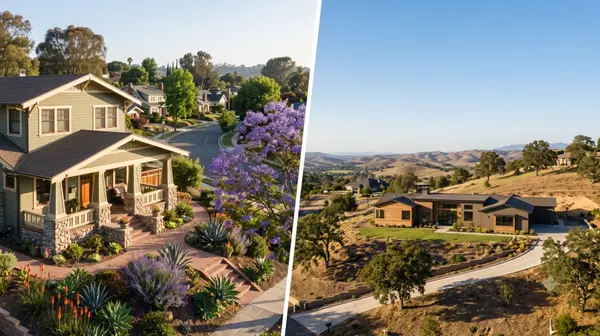
Mount Helix and nearby hillside properties often offer larger lots, view decks, pools, custom architecture, and more separation between homes. Those features can be hard to find at the same scale closer to central San Diego or near the coast.
But the premium is not just about purchase price. It can also show up in the cost of ownership.
Buyers should evaluate:
- Roof age
- Drainage
- Slope and retaining walls
- Driveway access
- Pool condition
- Insurance considerations
- Septic or sewer details
- Tree maintenance
- Fire-hardening needs
- HVAC, electrical, and plumbing age
- Usability of the lot
- Stairs and long-term accessibility
For move-up buyers, Mount Helix may make sense if the goal is a long-term home with more outdoor space and privacy. For downsizers, the same property may feel like too much maintenance.
The view can be compelling. The inspection report still matters.
MY TAKE: Mount Helix is worth considering when you will use the space and can comfortably maintain the property. Do not pay a premium for features that do not fit your daily life. Walk around Mt Helix streets at your own risk, with minimal sidewalks.
What’s Rolando Like to Live In? Is It Up and Coming?
Rolando is often discussed by buyers who want an older-home neighborhood near La Mesa, SDSU, and central San Diego. It can appeal to people looking for character, location, and relative value compared with more expensive central San Diego neighborhoods.
But “up and coming” is a phrase to use carefully.
It can imply momentum, renovation activity, and buyer interest. It can also oversimplify a neighborhood and lead buyers to make assumptions that are not useful or fair.
A better way to evaluate Rolando is by looking at objective factors:
- Recent comparable sales
- Renovation activity
- Street condition
- Parking
- Lot usability
- Noise from nearby corridors
- Proximity to La Mesa, SDSU, and freeways
- Walkability
- Rental mix by block
- Home condition
- Long-term resale demand
Rolando may be a strong fit for buyers who want proximity and character without moving farther east. It may not fit buyers who want larger lots, newer construction, or quieter hillside settings.
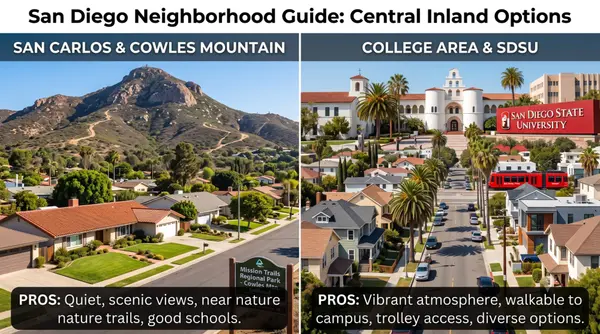
Move-up buyers often compare Rolando against La Mesa, College Area, San Carlos, Del Cerro, and Lemon Grove. Each option has a different price, commute, lot size, and housing-stock profile.
MY TAKE: Do not buy Rolando because of a trend label. Buy it because the specific home, block, commute, price, and resale story make sense.
Learn about The Rolando Catwalks
Which La Mesa Neighborhood Has the Best Walkability?
For walkability, buyers usually start with La Mesa Village and the surrounding downtown La Mesa area.
La Mesa overall is not uniformly walkable. Walk Score rates La Mesa as somewhat walkable, with an average score of 60. However, specific Village-area addresses can score much higher. For example, one La Mesa Boulevard location shows a Walk Score of 90, which Walk Score classifies as a “Walker’s Paradise.”
That difference is important.
Walkability changes block by block. A home near La Mesa Village may offer access to restaurants, coffee, services, trolley stations, parks, and community events. A hillside home may offer views and privacy but require driving for most errands.
Buyers should define walkability based on how they live.
For some, walkability means restaurants and coffee. For others, it means sidewalks, parks, transit, grocery access, medical offices, or the ability to complete daily errands without a car.
What to Check Before Buying for Walkability
Walk the area at different times.
Look for:
- Sidewalks
- Crosswalks
- Lighting
- Traffic speed
- Hills
- Parking patterns
- Noise
- Trolley distance
- Park access
- Grocery and coffee access
- Shade and comfort
- Route quality, not just distance
A high walk score can help, but it does not replace walking the route yourself.
MY TAKE: La Mesa Village is usually the strongest walkability play. Other La Mesa pockets may offer better privacy, parking, lot size, or views.
What is it really like to live in La Mesa
We’re Relocating From Out of State — Is La Mesa More Rental/Transient or Are There Many Neighborhood Homeowners?
La Mesa has a mix of homeowners and renters. It is not purely a rental market, and it is not purely owner-occupied suburbia.
Census QuickFacts reports La Mesa’s owner-occupied housing unit rate at 47.7% for 2020–2024. The same Census profile reports a median value of owner-occupied housing units of $812,000 and median gross rent of $2,049 for 2020–2024.
That mix matters for relocation buyers.
La Mesa includes:
- Longtime homeowners
- First-time buyers
- Move-up buyers
- Downsizers
- Condo owners
- Apartment renters
- Trolley-adjacent renters
- Multi-generational households
- Workers commuting across San Diego County
The feel of the area depends heavily on the exact pocket.
A condo near transit will feel different from a hillside single-family home. A home near La Mesa Village will feel different from a property near Mount Helix. A street with mostly detached homes will feel different from a corridor with more apartments.
That does not make one better than the other. It means buyers need to match the location to their lifestyle.
What Out-of-State Buyers Should Evaluate
Relocation buyers should pay close attention to:
- Housing type on the block
- Parking
- Commute routes
- Noise
- Freeway access
- Transit access
- School boundaries if relevant
- Proximity to shopping and healthcare
- Condition of nearby properties
- Local rental and ownership mix
- How the area feels at different times of day
Online comments can help buyers build a shortlist. They should not replace local due diligence.
MY TAKE: La Mesa has many established neighborhoods and many rental options. The right fit depends on the specific street, property type, and daily routine.
How Close Is La Mesa to the Beach Really?
La Mesa is close enough for regular beach trips, but it is not a beach community.
That is the honest answer.
From central La Mesa, many beach destinations are roughly 25 to 35 minutes by car in lighter traffic. That can include Mission Beach, Pacific Beach, Ocean Beach, Coronado, or La Jolla depending on route and timing.
Traffic changes the answer. Summer weekends, rush hour, Padres games, holiday weekends, and coastal events can stretch the drive.
The trade-off is value and space.
Many buyers consider La Mesa because they can often get more home, more parking, and more yard than they could near the coast at the same budget. They still get access to beaches, downtown, Mission Valley, SDSU, and East County.
That trade-off works well for buyers who want beach access but do not need a beach lifestyle every day.
It may not work for buyers who want to surf before work, walk to the sand, or live in a coastal microclimate.
MY TAKE: La Mesa is beach-accessible, not beach-adjacent. Buyers should be honest about how often they will go to the coast and what kind of daily lifestyle they expect.
How Move-Up Buyers Should Think About La Mesa
Move-up buyers usually need the next home to solve a real problem.
That may be:
- More square footage
- A better floor plan
- A dedicated office
- More outdoor space
- Better parking
- More storage
- A quieter street
- A shorter commute
- A different school boundary
- Space for guests or extended household needs
La Mesa can be attractive because it offers several different housing profiles in one city. Buyers can compare smaller homes near the Village, larger hillside properties, condos near Grossmont, and established single-family neighborhoods.
But the search needs structure.
A move-up buyer should know the maximum comfortable payment, likely sale proceeds from the current home, preferred commute, must-have floor plan features, and realistic trade-offs before touring.
That matters even more when moving from another San Diego neighborhood or relocating from out of state. La Mesa may offer better space for the money than coastal or central neighborhoods, but the right pocket still matters.
How Downsizers Should Think About La Mesa
Downsizers should look at La Mesa through a different lens.
The goal is not always to buy the biggest home possible. It is to buy the home that makes daily life easier.
That may mean:
- Single-level living
- Lower maintenance
- Less yard work
- Better walkability
- Elevator access if buying a condo
- Easier parking
- Proximity to healthcare
- Nearby restaurants and services
- Less unused space
- Strong resale appeal
La Mesa Village, Grossmont-area condos, and smaller single-family homes may appeal to buyers who want convenience. Mount Helix or hillside homes may appeal to those who still want space and privacy.
The key is clarity. Downsizing should simplify life, not create a new maintenance burden.
A practical guide for 'move-up' families
Fair Housing Note for Buyers Researching La Mesa
When comparing neighborhoods, focus on objective criteria.
Appropriate factors include:
- Home price
- Commute time
- School boundaries and public data
- Property condition
- Walkability
- Transit access
- Lot size
- Noise
- Parking
- HOA rules
- Local amenities
- Resale potential
Avoid relying on assumptions about who lives in a neighborhood or whether an area is “for” a certain type of person. Federal and California Fair Housing laws are designed to protect equal housing opportunity. A good buying strategy should help you compare facts, not stereotypes.
Bottom Line: Moving to La Mesa Depends on the Specific Pocket
Moving to La Mesa can make sense for buyers who want established neighborhoods, central access, trolley options, and more housing variety than many coastal areas offer at the same price.
But La Mesa is not one single lifestyle.
La Mesa Village is different from Mount Helix. Rolando-adjacent areas are different from Grossmont. A walkable condo location is different from a hillside single-family home. School assignments, commute routes, property condition, and long-term ownership costs can vary from one address to the next.
For move-up buyers, La Mesa may offer the space and flexibility that a current home no longer provides. For relocation buyers, it can offer access to San Diego without choosing a coastal price point. For downsizers, it can offer convenience, services, and established neighborhoods.
Thinking about moving to La Mesa from another part of San Diego or out of state? Start with a neighborhood-by-neighborhood strategy. The right pocket matters as much as the right house.
FAQ: Moving to La Mesa
Is La Mesa a good place to move if I want more space?
La Mesa can be a strong option for buyers who want more space than many central or coastal San Diego neighborhoods offer at the same budget. The best fit depends on your price range, commute, home style, and preferred neighborhood feel.
How are schools in La Mesa?
School experiences vary by campus, program, and assigned boundary. Buyers should confirm the assigned schools for each address and review official district and state data before making a decision.
Does La Mesa have trolley access?
Yes. La Mesa has trolley access through stations including La Mesa Blvd, Spring Street, Grossmont Transit Center, and nearby stops. The trolley is most useful when both your home and destination work with the route.
Is Mount Helix part of La Mesa?
Mount Helix is commonly associated with the La Mesa area, but many properties are in the unincorporated Casa de Oro-Mount Helix area. Buyers should verify jurisdiction, services, taxes, utilities, and property details by address.
Is Mount Helix worth paying more for?
Mount Helix may be worth the premium if you value views, privacy, larger lots, and custom homes. Buyers should also account for maintenance, slope, drainage, insurance, and inspection findings.
Is Rolando considered La Mesa?
Rolando is a San Diego neighborhood located near La Mesa. Buyers often compare Rolando with La Mesa because of proximity, older homes, and access to central San Diego and East County.
What part of La Mesa is most walkable?
La Mesa Village and nearby downtown streets are usually among the most walkable areas. Walkability varies by block, so buyers should test the actual route before buying.
Is La Mesa mostly homeowners or renters?
La Mesa has a mix of homeowners and renters. Census QuickFacts reports an owner-occupied housing unit rate of 47.7% for 2020–2024, so the ownership mix varies by neighborhood and housing type.
How far is La Mesa from the beach?
La Mesa is often about 25 to 35 minutes from several beaches in lighter traffic. Drive times can be longer during rush hour, summer weekends, and coastal events.
Is La Mesa better for move-up buyers or downsizers?
La Mesa can work for both. Move-up buyers may value more space, yards, and established neighborhoods, while downsizers may value walkability, transit, healthcare access, and lower-maintenance housing options.
Chris Melingonis - The Realtor Dad

Chris Melingonis, also known as The Realtor Dad, is a real estate agent serving La Mesa, San Diego, and nearby East County communities. He helps families, first-time homebuyers, move-up buyers, and home sellers make smart real estate decisions with clear guidance and local market knowledge.
Chris works closely with buyers who want more than just access to listings. He helps clients understand neighborhoods, compare homes honestly, think through resale value, and move forward with confidence. Whether someone is buying their first home or moving into a larger home for a growing family, his goal is to make the process feel less stressful and more manageable.
For sellers, Chris focuses on strong pricing strategy, smart marketing, and clear communication from start to finish. He helps homeowners prepare, position, and market their homes in a way that stands out in the La Mesa and greater San Diego market. His approach is built to attract serious buyers and help sellers protect their bottom line.
Clients choose Chris because he combines experience, local insight, and a down-to-earth style that puts people at ease. He believes buyers and sellers deserve honest advice, practical answers, and a real strategy, not pressure. His business is built around relationships, trust, and helping people make the right move for their family and future.
Recent Posts